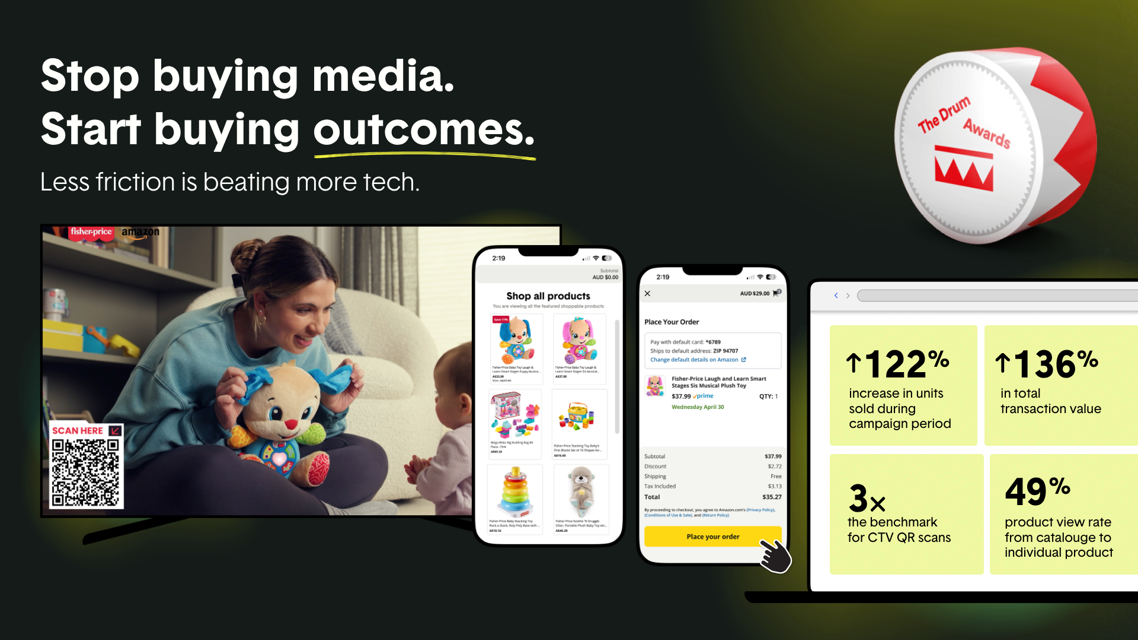
I spent last week in Miami at the inaugural Drum Awards for Commerce Media. By the time the lights came up I'd watched our team collect five trophies for the Mattel campaign, including the President's Award. Plenty of reason to be pleased. But the thing I haven't been able to shake since is a quieter question: what were we actually rewarding?
The pattern across the winners
Look at the night's headline winners and a pattern surfaces fast. Wavemaker, Incremental, Skai and Church & Dwight took the Grand Prix for connecting daily incrementality measurement directly to live campaign optimisation. Best Buy Ads was named Network of the Year for repositioning a retail business as a media business. Roundel's Precision Plus picked up Best Off-Site Performance for using commerce signals to drive results well beyond Target's own walls. Our work with Mattel turned video into a transactional surface, with Fisher-Price ads on Tubi that didn't ask the viewer to remember anything later.
None of these campaigns won because they ran more impressions, reached more people, or used a shinier stack. They won because they produced an outcome a CFO can find on a P&L. Incremental sales. Units moved. In-store lift. Transaction value. The judges weren't grading media plans. They were grading proof of contribution. That's a meaningful change, and it didn't come with an industry press release.
The shift nobody announced
For most of my career, we've bought media. Impressions, reach, GRPs, CPMs, CPCs, viewability, share of voice. All of them proxies for the thing the business actually wanted, which was a transaction. We optimised the proxies and asked the business to trust the chain.
That trade is quietly ending. The brands taking commerce media seriously have stopped buying media and started buying outcomes. They're not paying for the chance to be seen. They're paying for units in baskets, customers acquired, and incremental sales. The unit of value has changed.
It's a bigger shift than the industry has owned up to. When the unit of value changes, everything downstream of it has to change with it. How budgets get justified, how agencies get briefed, how procurement writes contracts, how creative gets evaluated, how media owners get measured. Most of the plumbing built between 2010 and 2024 was designed for a world that paid for impressions. We haven't rebuilt it for a world that pays for outcomes. So the brands moving fastest are doing it inside infrastructure that wasn't built for the job, and winning anyway.
That gap between the way we buy now and the way the industry is wired is the entire opportunity in front of us.
Why this exposes the five-year lie
Once you accept that the unit of value is an outcome, every layer of friction between the ad and the transaction becomes a tax on the thing you're paying for. A redirect is a tax. A new platform login is a tax. A "scan now, transact later, on a different device" mechanic is a tax. A six-month tech migration before you can run your first shoppable campaign is the biggest tax of all.
The narrative the industry has been sold for the last five years is that commerce media requires a rebuild. New stack. New team. New data infrastructure. New everything. CMOs who bought that story have spent millions and shipped little. The ones who didn't are now sitting on a measurable lead. They quietly added a commerce layer to the media they were already running, with the partners they already had. Less plumbing, more revenue. "You need to rebuild" wasn't a strategy. It was a tax dressed up as sophistication.
What outcome-buying looks like operationally
If you take the principle seriously, three operating disciplines fall out of it.
Activate where the audience already is. Every redirect is a tax. The audience watching CTV doesn't need to be sent somewhere to transact. The transaction needs to come to them. The audience scrolling social doesn't need to be funnelled to a microsite. The audience reading editorial doesn't need a fourteen-step path to checkout. The format follows the attention, not the other way around.
Use the partners already on the plan. Every new procurement cycle is a tax. The DSPs, SSPs, agencies and rich media providers a brand is already running represent years of negotiated relationships, integrated data, agreed terms and tested workflows. Throwing that out to "do commerce media" is almost always a worse trade than turning that existing stack shoppable. The fastest path is the one that doesn't restart the procurement clock.
Make commerce part of the creative, not the click after it. Every extra click is a tax. The creative is the unit consumers actually engage with. If the transaction lives one click away from it, you've conceded most of the conversion before the consumer even hesitates. The creative is the storefront. Treat it that way.
These aren't ideas. They're the operating rhythm of every brand winning the new game.
Mattel, earned not led
Which brings me back to Miami, and to the Mattel campaign. We didn't buy media on that work. We bought 122% more units sold. We bought 136% more transaction value. We bought interaction rates 5.6 times the benchmark. We bought a doubling of in-store sales year on year. We bought the President's Award. And we did it on a Yahoo DSP plan with KINESSO Australia, News Corp Australia and Afterpay. Partners that were already on the schedule, with creative the brand already had in market. No rebuild. No new stack. No new procurement cycle. The friction was removed. The outcome showed up.
That's not a Vudoo case study. It's an industry signpost. The work we recognised in Miami is what becomes table stakes everywhere else next.
What the next twelve months looks like
A few predictions worth writing down. Inside twelve months, CFOs will start asking why media budgets aren't reported in outcomes, and the agencies that can't answer cleanly will lose accounts. Procurement teams will start writing outcome-based contracts as the default, not the experiment. The CMOs who can't answer "what did we buy?" in transaction terms will be replaced by ones who can. And the brands still waiting on a stack rebuild before they activate commerce media will, by 2027, find themselves competing against brands that have been compounding outcome data for two years.
The advantage isn't going to the most-built. It's going to the least-blocked.
Stop buying media. Start buying outcomes. And when you do, you'll find the path was shorter than anyone told you it would be.
Learn more about the Drum Awards for Commerce Media winners 2026 here.
Paul Blackburn, Chief Growth Officer | Vudoo